Beyond Evaluation: Operational Intelligence for AI Systems
Modern AI systems are no longer isolated model endpoints.
They are becoming operational runtime environments composed of:
- multiple providers,
- routing systems,
- retrieval pipelines,
- memory layers,
- tool execution,
- and adaptive orchestration logic.
As AI systems evolve into operational infrastructure, a fundamental limitation begins to emerge:
Evaluation alone is insufficient.
The Shift from Models to Systems
Traditional evaluation methods were designed for static models under controlled conditions. Benchmarks and offline testing remain important, but they do not explain how AI systems behave under real runtime constraints.
Operational systems introduce different questions entirely:
- Which provider behaves reliably under latency pressure?
- Which execution path consistently succeeds?
- Which tools degrade long-running workflows?
- Which routing decisions improve stability over time?
- How should systems adapt when runtime behaviour changes?
These are not purely evaluation problems.
They are operational intelligence problems.
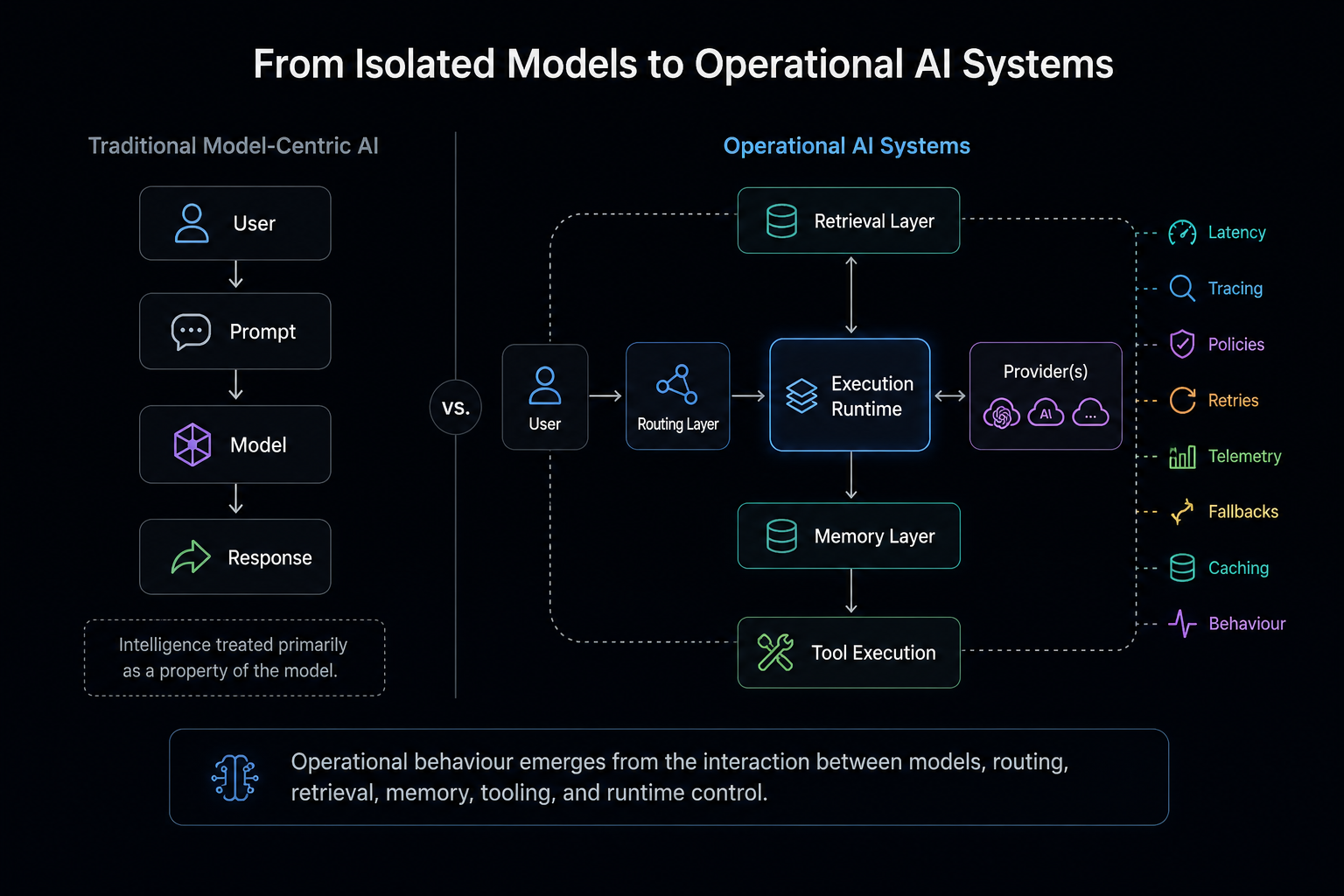
From Model Intelligence to Operational Intelligence
Most AI infrastructure still treats intelligence as a property of the model itself.
In practice, operational behaviour emerges from the interaction between:
- models,
- routing logic,
- retrieval systems,
- memory,
- tools,
- and runtime control mechanisms.
A strong model can still produce unreliable operational behaviour if:
- routing is unstable,
- retrieval is inconsistent,
- execution policies are poorly controlled,
- or runtime adaptation is absent.
As a result, behavioural reliability becomes a systems problem rather than a model problem.
Runtime Observability
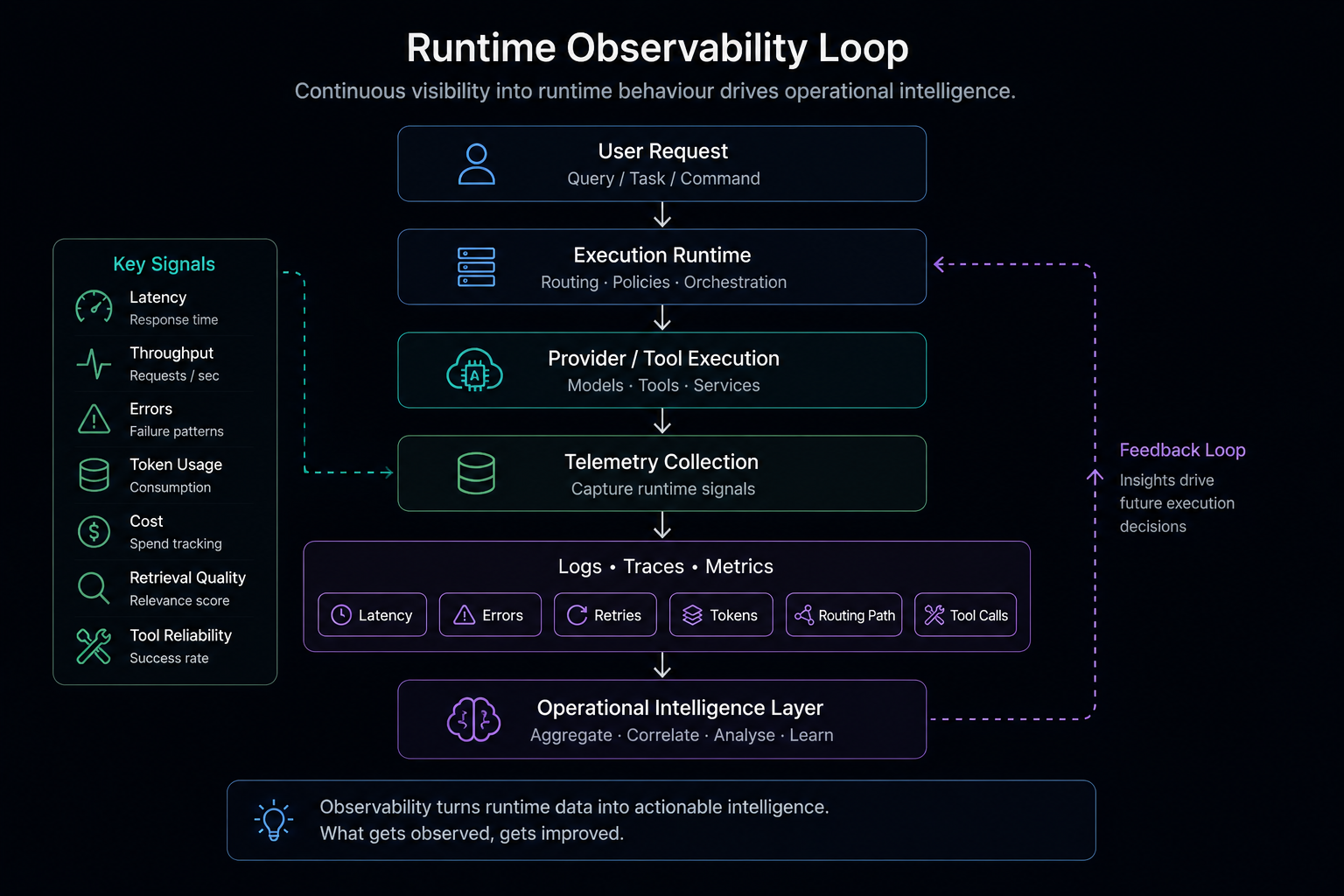
Operational AI systems require visibility into:
- execution traces,
- latency behaviour,
- provider degradation,
- routing outcomes,
- retrieval quality,
- and tool reliability.
Without runtime observability, systems cannot reason about operational quality.
Beyond Evaluation
Evaluation remains necessary.
However, reliable AI infrastructure will increasingly depend on systems capable of:
- understanding runtime behaviour,
- learning from operational outcomes,
- and adapting execution continuously.
As AI applications evolve into long-running operational environments, behavioural intelligence may become a foundational systems primitive rather than an optional optimisation layer.
Observability alone is not the final objective. The larger challenge is enabling AI systems to reason about operational behaviour under real runtime constraints.
Evaluation was the beginning. Operational intelligence may define the next infrastructure layer for AI systems.